Jean Racine
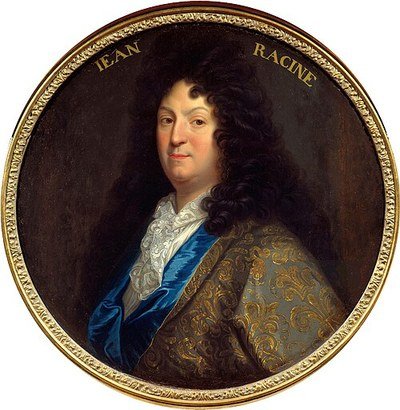
Jean-Baptiste Racine ( rass-EEN, US also rə-SEEN; French: [ʒɑ̃ batist ʁasin]; 22 December 1639 – 21 April 1699) was a French dramatist, one of the three great playwrights of 17th-century France, along with Molière and Corneille, as well as an important literary figure in the Western tradition and world literature. Racine was primarily a tragedian, producing such "examples of neoclassical perfection" as Phèdre, Andromaque, and Athalie. He did write one comedy, Les Plaideurs, and a muted tragedy, Esther, for the young.
Racine's plays displayed his mastery of the dodecasyllabic (12 syllable) French alexandrine. His writing is renowned for its elegance, purity, speed, and fury, and for what American poet Robert Lowell described as a "diamond-edge", and the "glory of its hard, electric rage". Racine's dramaturgy is marked by his psychological insight, the prevailing passion of his characters, and the nakedness of both plot and stage.
Racine was born on 21 December 1639 in La Ferté-Milon (Aisne), in the province of Picardy in northern France. Orphaned by the age of four (his mother died in 1641 and his father in 1643), he came into the care of his grandparents. At the death of his grandfather in 1649, his grandmother, Marie des Moulins, went to live in the convent of Port-Royal and took her grandson with her. He received a classical education at the Petites écoles de Port-Royal, a religious institution which would greatly influence other contemporary figures including Blaise Pascal. Port-Royal was run by followers of Jansenism, a theology condemned as heretical by the French bishops and the Pope. Racine's interactions with the Jansenists in his years at this academy would have great influence over him for the rest of his life. At Port-Royal, he excelled in his studies of the classics and the themes of Greek and Roman mythology would play large roles in his future works.
Biography adapted from the Wikipedia article “Jean Racine”, CC BY-SA. Read it there.