Wolfram von Eschenbach
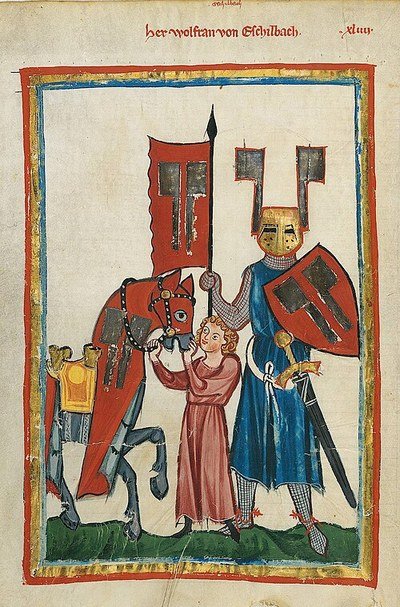
Wolfram von Eschenbach (German: [ˈvɔlfʁam fɔn ˈɛʃn̩bax]; c. 1160/80 – c. 1220) was a German knight, poet and composer, regarded as one of the greatest epic poets of medieval German literature. As a Minnesinger, he also wrote lyric poetry.
Little is known of Wolfram's life. There are no historical documents which mention him, and his works are the sole source of evidence. In Parzival, he talks of wir Beier ("we Bavarians"); the dialect of his works is East Franconian. On the basis of this and a number of geographical references, the present-day Wolframs-Eschenbach, until 1917 Obereschenbach, near Ansbach in present-day Bavaria, has been officially designated as his birthplace. However, the evidence is circumstantial and not without problems – there are at least four other places named Eschenbach in Bavaria, and Wolframs-Eschenbach was not part of the Duchy of Bavaria (Altbayern, 'Old Bavaria') in Wolfram's time.
The arms shown in the Manesse manuscript come from the imagination of a 14th-century artist, drawing on the figure of the Red Knight in Parzival, and have no heraldic connection with Wolfram. Wolfram's work indicates a number of possible patrons (most reliably Hermann I of Thuringia), which suggests that he served at a number of courts during his life. He was presumably not a wealthy man, as he made frequent allusions to his own poverty.
Biography adapted from the Wikipedia article “Wolfram von Eschenbach”, CC BY-SA. Read it there.