William Langland
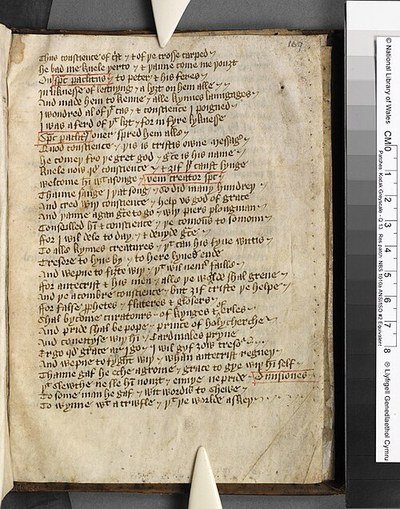
William Langland (; Latin: Willielmus de Langland; c. 1330 – c. 1386) is the presumed author of a work of Middle English alliterative verse generally known as Piers Plowman, an allegory with a complex variety of religious themes. The poem translated the language and concepts of the cloister into symbols and images that could be understood by a layman.
Little is known of Langland himself. It seems that he was born in the West Midlands of England around 1330, according to internal evidence in Piers Plowman. The narrator in Piers Plowman receives his first vision while sleeping in the Malvern Hills (between Herefordshire and Worcestershire), which suggests some connection to the area. The dialect of the poem is also consistent with this part of the country. Piers Plowman was written c. 1377, as the character's imagination says he has followed him for "five and forty winters."
A fifteenth-century note in the Dublin manuscript of Piers Plowman says that Langland was the son of Stacy de Rokayle.
Biography adapted from the Wikipedia article “William Langland”, CC BY-SA. Read it there.