Virgil
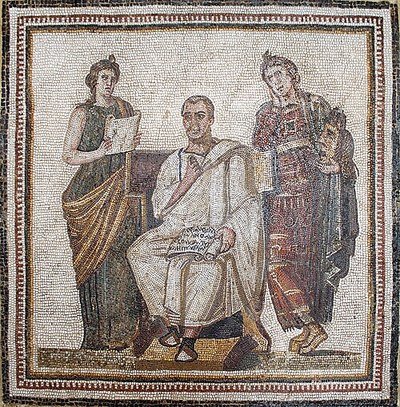
Publius Vergilius Maro (Classical Latin: [ˈpuːbliʊs wɛrˈɡɪliʊs ˈmaroː]; 15 October 70 BC – 21 September 19 BC), usually called Virgil or Vergil ( VUR-jil) in English, was an ancient Roman poet of the Augustan period. He composed three of the most famous poems in Latin literature: the Eclogues (or Bucolics), the Georgics, and the epic Aeneid. Some minor poems, collected in the Appendix Vergiliana, were attributed to him in ancient times, but modern scholars regard these as spurious, with the possible exception of some short pieces.
Already acclaimed in his lifetime as a classic author, Virgil rapidly replaced Ennius and other earlier authors as a standard school text, and stood as the most popular Latin poet through late antiquity, the Middle Ages, and early modernity, exerting major influence on Western literature. Geoffrey Chaucer assigned Virgil a uniquely prominent position in history in The House of Fame (1374–85), describing him as standing on a pilere / that was of tinned yren clere ("on a pillar that was of bright tin-plated iron"), and in the Divine Comedy, in which Virgil appears as the author's guide through Hell and Purgatory, Dante pays tribute to Virgil with the words tu se' solo colui da cu'io tolsi / lo bello stile che m'ha fatto onore (Inf. I.86–7) ("thou art alone the one from whom I took the beautiful style that has done honour to me"). In the 20th century, T. S. Eliot famously began a lecture on the subject "What Is a Classic?" by asserting as self-evidently true that "whatever the definition we arrive at, it cannot be one which excludes Virgil – we may say confidently that it must be one which will expressly reckon with him".
Biographical information about Virgil is transmitted chiefly in vitae ("lives") of the poet, prefixed to commentaries on his work by Probus, Donatus, and Servius. The life given by Donatus is considered to closely reproduce the life of Virgil from a lost work of Suetonius on the lives of famous authors, just as Donatus used it for the poet's life in his commentary on Terence, where Suetonius is explicitly credited. The far shorter life given by Servius likewise seems to be an abridgement of Suetonius except for one or two statements. Varius is said to have written a memoir of his friend Virgil, and Suetonius likely drew on this lost work and other sources contemporary with the poet. A life written in verse by the grammarian Phocas (probably active in the 4th to 5th centuries AD) differs in some details from Donatus and Servius. Henry Nettleship believed the life attributed to Probus may have drawn independently from the same sources as Suetonius, but it is attributed by other authorities to an anonymous author of the 5th or 6th century AD who drew on Donatus, Servius, and Phocas. The Servian life was the principal source of Virgil's biography for medieval readers, while the Donatian life enjoyed a more limited circulation, and the lives of Phocas and Probus remained largely unknown.
Biography adapted from the Wikipedia article “Virgil”, CC BY-SA. Read it there.