Thomas Hoccleve
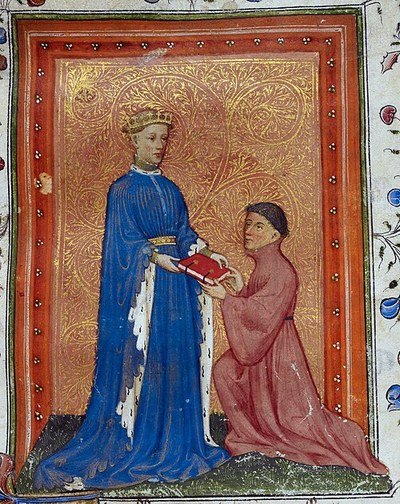
Thomas Hoccleve or Occleve (1368/69–1426) was a key figure in 15th-century Middle English literature, significant for promoting Chaucer as "the father of English literature", and as a poet in his own right. His poetry, especially his longest work, the didactic work Regement of Princes, was extremely popular in the fifteenth century, but went largely ignored until the late twentieth century, when it was re-examined by scholars, particularly John Burrow. Today he is best known for his Series, which includes the earliest autobiographical description of mental illness in English, and for his extensive scribal activity. Three holographs of his poetry have survived, and he also copied literary manuscripts by other writers. As a clerk of the Office of the Privy Seal, he wrote hundreds of documents in French and Latin.
Hoccleve was born in 1368, as he states when writing in 1421 (Dialogue, 1.246) that he has seen "fifty wyntir and three". Little is known of his family, but they probably came from the village of Hockliffe in Bedfordshire. In November 1420, Hoccleve's fellow Privy Seal clerk John Bailey returned land and tenements in Hockliffe to him, which suggests that Hoccleve may indeed have retained family ties there. But records show that Hoccleve's father William Hoccleve was a Draper operating in London prior to 1365, so the poet may have been born and raised in London.
What is known of his life comes mainly from his works and from administrative records. According to the Regiment of Princes (c. 1411, 11.804–5), he obtained a clerkship in the Office of the Privy Seal at the age of eighteen or nineteen, which he retained on and off, in spite of much grumbling, for about thirty-five years. On 12 November 1399 he was granted an annuity by the new king, Henry IV. It was not always paid as regularly as he would have wished, or in full; he is known for complaining about his lack of funds.
Biography adapted from the Wikipedia article “Thomas Hoccleve”, CC BY-SA. Read it there.