Samuel Butler
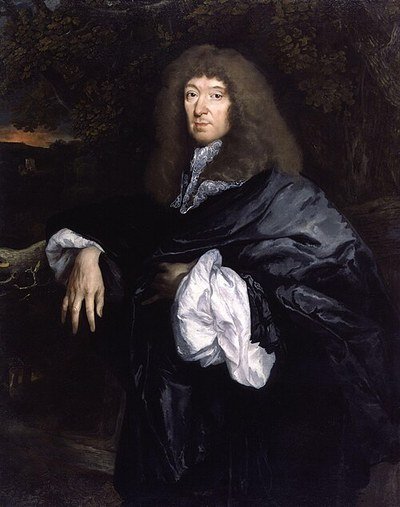
Samuel Butler (baptized 14 February 1613 – 25 September 1680) was an English poet and satirist. He is remembered now chiefly for a long satirical poem titled Hudibras.
Samuel Butler was born in Strensham, Worcestershire, and was the son of a farmer and churchwarden, also named Samuel, and his wife Mary. His date of birth is unknown, but there is documentary evidence for the date of his baptism of 14 February. The date of Butler's baptism is given as 8 February by Treadway Russell Nash in his 1793 edition of Hudibras. Nash had already mentioned Butler in his Collections for a History of Worcestershire (1781), and perhaps because the latter date seemed to be a revised account, it has been repeated by many writers and editors. However, the parish register of Strensham records under the year 1612: "Item was christened Samuell Butler the sonne of Samuell Butler the xiiijth of February anno ut supra". Lady Day, 25 March, was New Year's Day in England at the time, so the year of his baptism was 1613 according to the change of the start of the year with the Calendar Act of 1750 (see Old Style and New Style dates). Nash also claims in his 1793 edition of Hudibras that Butler's father entered his son's baptism into the register, an error that was also repeated in later publications; however, the entry was clearly written by a different hand.
Butler was brought up in the household of Sir William Russell of Strensham and became his clerk. "When just a Boy he would make observations and reflections on every Thing one sayd or did, and censure it to be either well or ill. He was never at the University for the reason alleged." He was educated at the King's School, Worcester, under Henry Bright whose teaching is recorded favourably by Thomas Fuller, a contemporary writer, in his Worthies of England. In early youth he was a servant to the Countess of Kent. Through Lady Kent he met her steward, the jurist John Selden who influenced his later writings. He also tried his hand at painting but was reportedly not very good at it; one of his editors reporting that "his pictures served to stop windows and save the tax" (on window glass). Conversely, John Aubrey who knew Butler quite well enough to be one of his pallbearers, wrote that "He was thinking once to have made painting his Profession. His love to and skill in painting made a great friendship between him and Mr. Samuel Cowper (The Prince of Limners of this Age)." He studied law but did not practice.
Biography adapted from the Wikipedia article “Samuel Butler (poet)”, CC BY-SA. Read it there.