Robert Browning
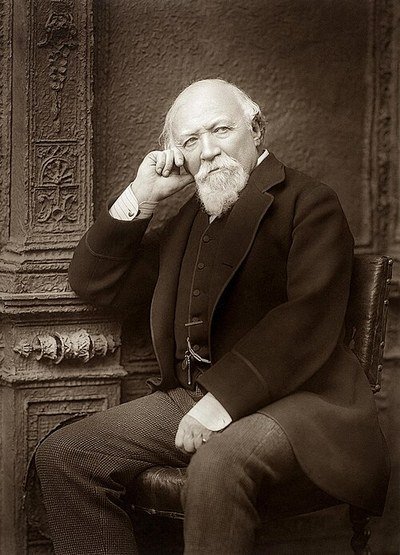
Robert Browning (7 May 1812 – 12 December 1889) was an English poet and playwright whose dramatic monologues put him high among the Victorian poets. He was noted for irony, characterisation, dark humour, social commentary, historical settings and challenging vocabulary and syntax.
His early long poems Pauline (1833) and Paracelsus (1835) were acclaimed, but his reputation dwindled for a time – his 1840 poem Sordello was seen as wilfully obscure – and took over a decade to recover, by which time he had moved from Shelleyan forms to a more personal style. In 1846, he married fellow poet Elizabeth Barrett and moved to Italy. By her death in 1861, he had published the collection Men and Women (1855). His Dramatis Personae (1864) and book-length epic poem The Ring and the Book (1868–1869) made him a leading poet. By his death in 1889, he was seen as a sage and philosopher-poet who had fed into Victorian social and political discourse. Societies for studying his work survived in Britain and the US into the 20th century.
Browning was born in Walworth in the parish of Camberwell, Surrey, which now forms part of the Borough of Southwark in south London. He was baptised on 14 June 1812, at Lock's Fields Independent Chapel, York Street, Walworth, the only son of Sarah Anna (née Wiedemann) and Robert Browning. His father was a well-paid clerk for the Bank of England, earning about £150 per year. Browning's paternal grandfather was a slave owner in Saint Kitts, West Indies, but Browning's father was an abolitionist. Browning's father had been sent to the West Indies to work on a sugar plantation but returned to England following a slave revolt. Browning's mother was the daughter of a German shipowner who had settled in Dundee, Scotland with his Scottish wife. His paternal grandmother, Margaret Tittle, had inherited a plantation in St Kitts and was rumoured in the family to have a mixed-race ancestry including some Jamaican blood, but author Julia Markus suggests she was Kittitian rather than Jamaican. The evidence is inconclusive. Robert's father, a literary collector, had a library of some 6,000 books; many of them were rare so that Robert grew up in a household with significant literary resources. His mother, to whom he was close, was a devout nonconformist and a talented musician. His younger sister, Sarianna, also gifted, became her brother's companion in his later years, after the death of his wife in 1861. His father encouraged his children's interest in literature and the arts.
Biography adapted from the Wikipedia article “Robert Browning”, CC BY-SA. Read it there.