Robert Bloomfield
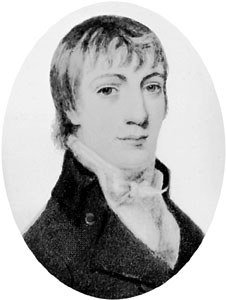
Robert Bloomfield (3 December 1766 – 19 August 1823) was an English labouring-class poet, whose work is appreciated in the context of other self-educated writers, such as Stephen Duck, Mary Collier and John Clare.
Robert Bloomfield was born into a poor family in the village of Honington, Suffolk. His father was a tailor, who died of smallpox when his son was a year old. It was from his mother Elizabeth, who kept the village school, that he received the rudiments of education.
Bloomfield was apprenticed at the age of eleven to his mother's brother-in-law, and worked on a farm that was part of the estate of the Duke of Grafton, his future patron. Four years later, owing to his small and weak stature (in adulthood just five feet tall), he was sent to London to work as a shoemaker under his elder brother George. One of his early duties was to read the papers aloud while the others in the workshop were working, and he became particularly interested in the poetry section of The London Magazine. He had his first poem, "The Village Girl", published in 1786. When his brother George returned to Suffolk in that year, he set up on his own as a cobbler and in 1790 married Mary Ann Church, by whom he was to have five children.
Biography adapted from the Wikipedia article “Robert Bloomfield”, CC BY-SA. Read it there.