Quintus Smyrnaeus
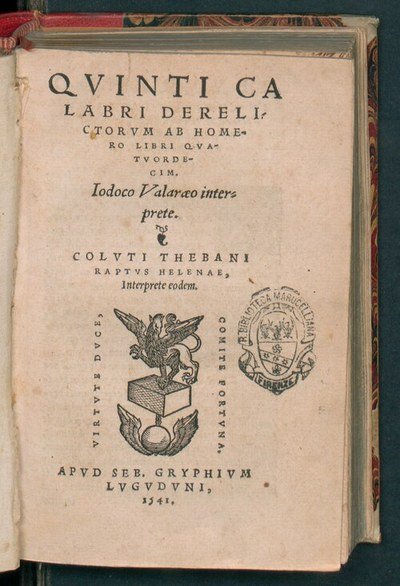
Quintus Smyrnaeus (also Quintus of Smyrna; Greek: Κόϊντος Σμυρναῖος, Kointos Smyrnaios) was a Greek epic poet whose Posthomerica, following "after Homer", continues the narration of the Trojan War. The dates of Quintus Smyrnaeus' life and poetry are disputed: by tradition, he is thought to have lived in the latter part of the 4th century AD, but earlier dates have also been proposed.
His epic in fourteen books, known as the Posthomerica, covers the period between the end of Homer's Iliad and the end of the Trojan War. Its primary importance is as the earliest surviving work to cover this period, the archaic works in the Epic Cycle, which he knew and drew upon, having been lost. His materials are borrowed from the cyclic poems from which Virgil (with whose works he was probably acquainted) also drew, in particular the Aethiopis (Coming of Memnon) and the Iliupersis (Destruction of Troy) of Arctinus of Miletus, and the Ilias Mikra (Little Iliad) of Lesches. His work is closely modeled on Homer.
The dates of Quintus's life are controversial, but they are traditionally placed in the latter part of the 4th century AD. Way suggests that "His date is approximately settled by two passages in the poem, viz. vi. 531 sqq., in which occurs an illustration drawn from the man-and-beast fights of the amphitheatre, which were suppressed by Theodosius I. (379–395 AD); and xiii. 335 sqq., which contains a prophecy, the special particularity of which, it is maintained by Koechly, limits its applicability to the middle of the fourth century AD."
Biography adapted from the Wikipedia article “Quintus Smyrnaeus”, CC BY-SA. Read it there.