Pindar
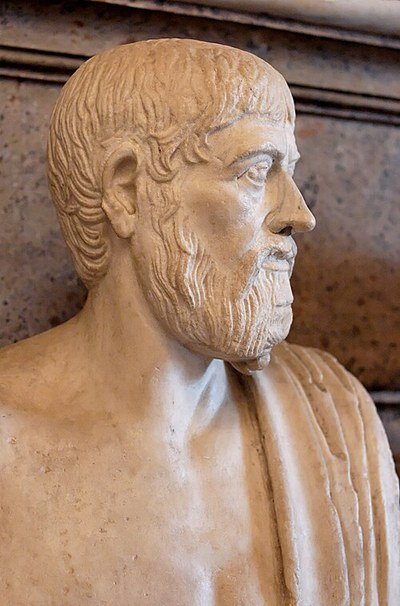
Pindar (; Ancient Greek: Πίνδαρος Pindaros [píndaros]; Latin: Pindarus; c. 518 BC – c. 438 BC) was an Ancient Greek lyric poet from Thebes. Of the canonical nine lyric poets of ancient Greece, his work is the best preserved. Quintilian wrote, "Of the nine lyric poets, Pindar is by far the greatest, in virtue of his inspired magnificence, the beauty of his thoughts and figures, the rich exuberance of his language and matter, and his rolling flood of eloquence, characteristics which, as Horace rightly held, make him inimitable." His poems can also, however, seem difficult and even peculiar. The Athenian comic playwright Eupolis once remarked that they "are already reduced to silence by the disinclination of the multitude for elegant learning".
Pindar was the first Greek poet to reflect on the nature of poetry and on the poet's role. His poetry illustrates the beliefs and values of Archaic Greece at the dawn of the Classical period.
Pindar was born circa 518 BC (the 65th Olympiad) in Cynoscephalae, a village in Boeotia, not far from Thebes. His father's name is variously given as Daiphantus, Pagondas or Scopelinus, and his mother's name was Cleodice. It is told that in his youth, or possibly infancy, bees built a honeycomb in his mouth and this was the reason he became a poet of honey-like verses. (An identical fate has been ascribed to other poets of the archaic period.) Pindar was about twenty years old in 498 BC when he was commissioned by the ruling family in Thessaly to compose his first victory ode (Pythian 10). He studied the art of lyric poetry in Athens, where his tutor was Lasos of Hermione, and he is also said to have received some helpful criticism from Corinna.
Biography adapted from the Wikipedia article “Pindar”, CC BY-SA. Read it there.