Nikolai Nekrasov
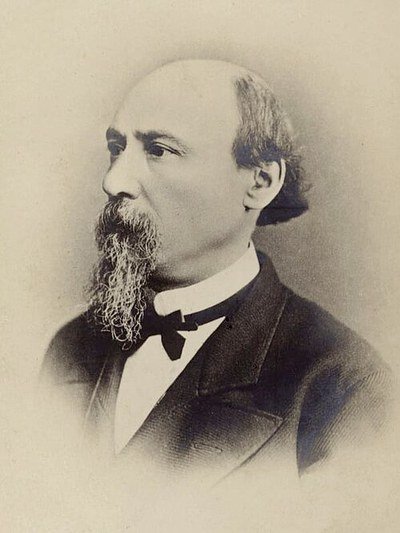
Nikolay Alexeyevich Nekrasov (Russian: Никола́й Алексе́евич Некра́сов, IPA: [nʲɪkɐˈlaj ɐlʲɪkˈsʲejɪvʲɪtɕ nʲɪˈkrasəf] , 10 December [O.S. 28 November] 1821 – 8 January 1878 [O.S. 27 December 1877]) was a Russian poet, writer, critic and publisher, whose deeply compassionate poems about the Russian peasantry made him a hero of liberal and radical circles in the Russian intelligentsia of the mid-nineteenth century, particularly as represented by Vissarion Belinsky and Nikolay Chernyshevsky. He is credited with introducing ternary meters and the technique of dramatic monologue (On the Road, 1845) to Russian poetry. As the editor of several literary journals, notably Sovremennik, Nekrasov was also singularly successful and influential.
Nikolay Alexeyevich Nekrasov was born in Nemyriv (now in Vinnytsia Oblast, Ukraine), in the Bratslavsky Uyezd of Podolia Governorate. His father, Alexey Sergeyevich Nekrasov (1788–1862), was descended from Russian landed gentry and was an officer in the Imperial Russian Army. There is some uncertainty as to his mother's origins. According to the Brockhaus and Efron Encyclopedic Dictionary (and this corresponds with Nekrasov's 1887 autobiographical notes), Nekrasov's mother was Alexandra Zakrzewska, a Polish noblewoman and the daughter of a wealthy landlord who belonged to the szlachta. The church records tell a different story, and modern Russian scholars have her name as Yelena Andreyevna. "Up until recently the poet's biographers had it that his mother belonged to a Polish family. In fact she was the daughter of Ukrainian state official Alexander Semyonovich Zakrevsky, the owner of Yuzvino, a small village in the Podolia Governorate," Korney Chukovsky asserted in 1967. Pyotr Yakubovich argued that the records might have been tampered with so as to conceal the fact that the girl had been taken from Poland without her parents' consent (Nekrasov in his autobiography states as much). D. S. Mirsky explained this discrepancy by suggesting that Nekrasov "created the cult of his mother, imparted her with improbable qualities and started worshipping her after her death."
In January 1823 Alexey Nekrasov, ranked army major, retired and moved the family to his estate in Greshnevo, Yaroslavl province, near the Volga River, where young Nikolai spent his childhood years with his five siblings, brothers Andrey (b. 1820), Konstantin (b. 1824) and Fyodor (b. 1827), sisters Elizaveta (b. 1821) and Anna (b. 1823). This early retirement from the army, as well as his job as a provincial inspector, caused Aleksey Sergeyevich much frustration resulting in drunken rages against both his peasants and his wife. Such experiences traumatized Nikolai and later determined the subject matter of his major poems that portrayed the plight of the Russian peasants and women. Nekrasov's mother loved literature and imparted this passion to her son; it was her love and support that helped the young poet to survive the traumatic experiences of his childhood which were aggravated by images of social injustice, similar to Fyodor Dostoyevsky's childhood recollections. "His was a wounded heart, and this wound that never healed served as a source for his passionate, suffering verse for the rest of his life," the latter wrote.
Biography adapted from the Wikipedia article “Nikolay Nekrasov”, CC BY-SA. Read it there.