Lord Byron
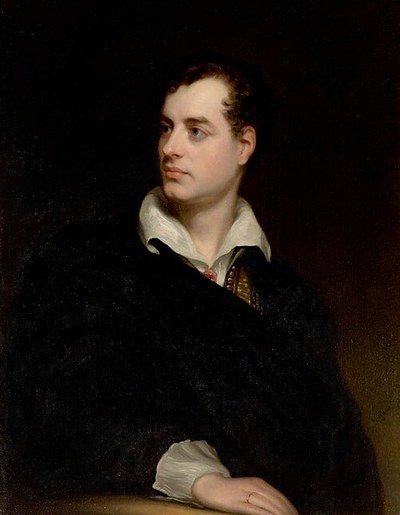
George Noel Gordon Byron, 6th Baron Byron (22 January 1788 – 19 April 1824), was a British poet. He was one of the major figures of the Romantic movement, and is regarded as being among the greatest British poets. Among his best-known works are the lengthy narratives Don Juan and Childe Harold's Pilgrimage; many of his shorter lyrics in Hebrew Melodies also became popular.
Byron was educated at Trinity College at the University of Cambridge. Following graduation, he travelled extensively in Europe, living for seven years in Italy, in Venice, Ravenna, Pisa, and Genoa, as he was forced to flee England after receiving threats of lynching. During his stay in Italy, he would frequently visit his friend and fellow poet Percy Bysshe Shelley. Later in life, Byron joined the Greek War of Independence to fight the Ottoman Empire, for which Greeks revere him as a folk hero. He died leading a campaign in 1824, at the age of 36, from a fever contracted after the first and second sieges of Missolonghi.
George Noel Gordon Byron was born on 22 January 1788, on Holles Street in London; his birthplace is now supposedly occupied by a branch of the department store John Lewis. His family in the English Midlands can be traced back without interruption to Ralph de Buran, who arrived in England with William the Conqueror in the 11th century. His land holdings are listed in the Domesday Book of 1086.
Biography adapted from the Wikipedia article “Lord Byron”, CC BY-SA. Read it there.