George Meredith
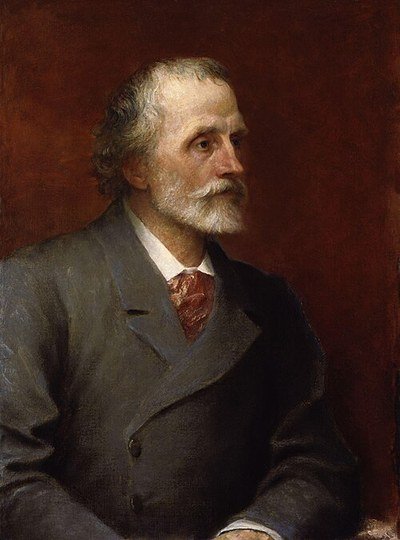
George Meredith (12 February 1828 – 18 May 1909) was an English novelist and poet of the Victorian era. At first, his focus was poetry, influenced by John Keats among others, but Meredith gradually established a reputation as a novelist. The Ordeal of Richard Feverel (1859) briefly scandalised Victorian literary circles. Of his later novels, the most enduring is The Egoist (1879), though in his lifetime his greatest success was Diana of the Crossways (1885). His novels were innovative in their attention to characters' psychology, and also portrayed social change. His style, in both poetry and prose, was noted for its syntactic complexity; Oscar Wilde likened it to "chaos illumined by brilliant flashes of lightning". Meredith was an encourager of other novelists, as well as an influence on them; among those to benefit were Robert Louis Stevenson and George Gissing. Meredith was nominated for the Nobel Prize in Literature seven times.
Meredith was born at 73 High Street, Portsmouth, Hampshire, England, the only child of Augustus Urmston Meredith and his wife Jane Eliza (née Macnamara). The name Meredith is Welsh, and he would describe himself as "half Irish and half Welsh" (on his mother's and father's sides, respectively). He was proud of his Welsh origins, and such pride is evident in his novels. His biographer Lionel Stevenson explains that Meredith's paternal grandfather, Melchizedek, would sometimes "boast eloquently of his princely forebears", but "between his immediate forebears and the legendary Welsh princes of seven centuries before, the history of the family remains obscure."
Augustus Meredith was, as Melchizedek Meredith had been before him, a naval outfitter, and among his employees was James Watson Gieve. Jane died when her son was five, and the outfitting business failed, with Augustus declared bankrupt in November 1838. He moved to London and in July 1839 remarried – his second wife being the family's former housekeeper, Matilda Buckett.
Biography adapted from the Wikipedia article “George Meredith”, CC BY-SA. Read it there.