George Lyttelton, Lord Lyttelton
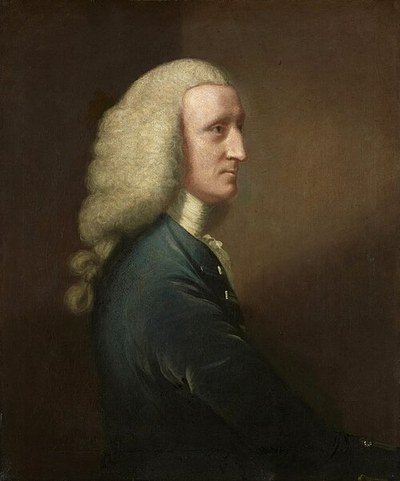
George Lyttelton, 1st Baron Lyttelton, (17 January 1709 – 22 August 1773), known between 1751 and 1756 as Sir George Lyttelton, 5th Baronet, was a British politician and writer who served as Chancellor of the Exchequer from 1755 to 1756. As an author himself, he was also a supporter of other writers and as a patron of the arts made an important contribution to the development of 18th-century landscape design.
Lord Lyttelton was the eldest son of Sir Thomas Lyttelton, 4th Baronet, of Frankley, in the County of Worcester, by his wife Christian, daughter of Sir Richard Temple, 3rd Baronet. Educated at Eton and Christ Church, Oxford, he afterwards went on grand tour, visiting Europe with his tutor. It was during this time that he started publishing his early works in both poetry and prose. Even after he was elected to Parliament in 1735, he continued to publish from time to time. In 1742 he married Lucy, daughter of Hugh Fortescue, and following her death in 1747 he later married Elizabeth, daughter of Field Marshal Sir Robert Rich, 4th Baronet, in 1749. He died in August 1773, aged 64, and was succeeded as baron by his eldest son, Thomas. Though Samuel Johnson's biographical notice of Lyttelton is characterised by a conspicuous show of dislike, it diverges at the end into a long description of his exemplary death and the plain inscription he asked to have added to his first wife's monument in St John the Baptist Church, Hagley.
Biography adapted from the Wikipedia article “George Lyttelton, 1st Baron Lyttelton”, CC BY-SA. Read it there.