George Eliot
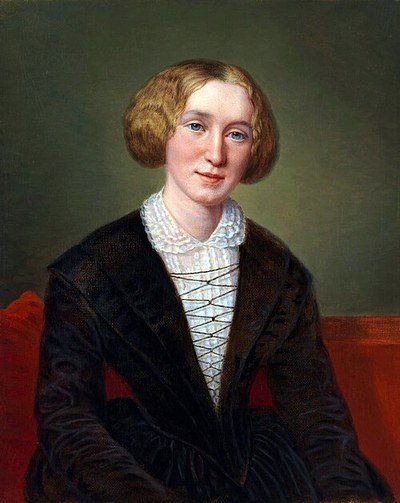
Mary Ann Evans (22 November 1819 – 22 December 1880; alternatively Mary Anne or Marian), known by her pen name George Eliot, was an English novelist, poet, journalist, translator, and one of the leading writers of the Victorian era. She wrote seven novels: Adam Bede (1859), The Mill on the Floss (1860), Silas Marner (1861), Romola (1862–1863), Felix Holt, the Radical (1866), Middlemarch (1871–1872) and Daniel Deronda (1876). Her novels are known for their realism, psychological insight, sense of place, and detailed depiction of the countryside. Middlemarch was described by the novelist Virginia Woolf as "one of the few English novels written for grown-up people" and by Martin Amis and Julian Barnes as the greatest novel in the English language.
Scandalously and unconventionally for the era, she lived with the married George Henry Lewes as his conjugal partner, from 1854 to 1878, and called him her husband. He remained married to his wife, Agnes Jervis, and supported their children, even after Jervis left him to live with another man and have children with him. In May 1880, 18 months after Lewes's death, Eliot married her longtime friend John Cross, a man much younger than she, and changed her name to Mary Ann Cross.
Mary Ann Evans was born in Nuneaton, Warwickshire, at South Farm on the Arbury Hall estate. She was the third child of Robert Evans (1773–1849), manager of the Arbury Hall estate, and Christiana Evans (née Pearson, 1788–1836), daughter of a local mill-owner. Her full siblings were: Christiana, known as Chrissey (1814–1859), Isaac (1816–1890), and twin brothers who died a few days after birth in March 1821. She also had a half-brother, Robert Evans (1802–1864), and half-sister, Frances "Fanny" Evans Houghton (1805–1882), from her father's previous marriage to Harriet Poynton (1780–1809). In early 1820, the family moved to a house named Griff House, between Nuneaton and Bedworth.
Biography adapted from the Wikipedia article “George Eliot”, CC BY-SA. Read it there.