Felicia Hemans
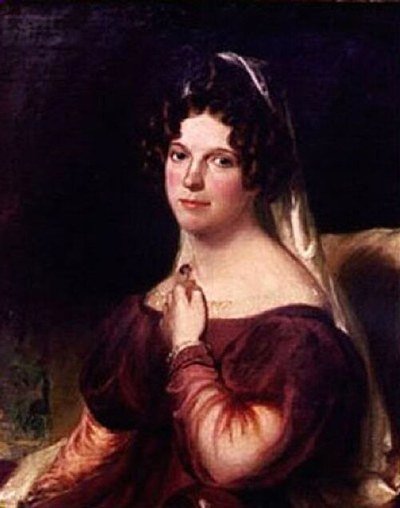
Felicia Dorothea Hemans (25 September 1793 – 16 May 1835) was an English poet (who identified as Welsh by adoption). Regarded as the leading female poet of her day, Hemans was immensely popular during her lifetime in both England and the United States, and was second only to Lord Byron in terms of sales. Two of her opening lines, "The boy stood on the burning deck" and "The stately homes of England", have acquired classic status.
Felicia Dorothea Browne was born on 25 September 1793, at 118 Duke Street, Liverpool. She was the daughter of George Browne, who worked for his father-in-law's wine importing business and succeeded him as Tuscan and imperial consul in Liverpool. Her mother, Felicity, was the daughter of Benedict Paul Wagner (1718–1806), wine importer at 9 Wolstenholme Square, Liverpool and Venetian consul for that city. Hemans was the fourth of six children (three boys and three girls) to survive infancy. Her sister Harriet collaborated musically with Hemans and later edited her complete works (7 vols. with memoir, 1839). George Browne's business soon brought the family to Denbighshire in North Wales, where she spent her youth. They lived in a cottage within the grounds of Gwrych Castle near Abergele when Felicia was seven years old until she was sixteen and in 1809 moved to Bronwylfa, St. Asaph (Flintshire). She later called Wales "Land of my childhood, my home and my dead". Lydia Sigourney says of her education:
The nature of the education of Mrs. Hemans, was favourable to the development of her genius. A wide range of classical and poetical studies, with the acquisition of several languages, supplied both pleasant aliment and needful discipline. She required not the excitement of a more public system of culture,—for the never-resting love of knowledge was her school master.
Biography adapted from the Wikipedia article “Felicia Hemans”, CC BY-SA. Read it there.