Edmund Gosse
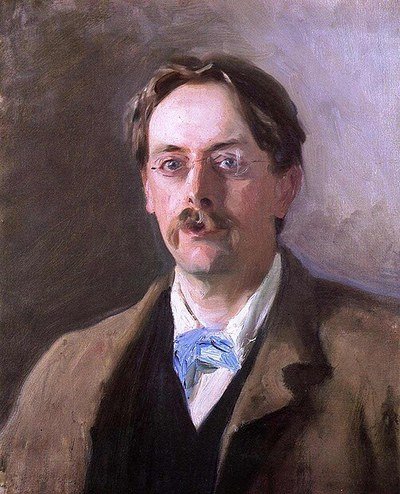
Sir Edmund William Gosse (; 21 September 1849 – 16 May 1928) was an English poet, author and critic. He was strictly brought up in a small Protestant sect, the Plymouth Brethren, but broke away sharply from that faith. His account of his childhood in the book Father and Son has been described as the first psychological biography.
His friendship with the sculptor Hamo Thornycroft inspired a successful career as a historian of late-Victorian sculpture. His translations of Henrik Ibsen helped to promote that playwright in England, and he encouraged the careers of Sarojini Naidu, Toru Dutt, W. B. Yeats and James Joyce. He also lectured in English literature at Cambridge University.
Gosse was the son of Philip Henry Gosse and Emily Bowes. His father was a naturalist and one of the chief figures among Brethren, his mother was a published poet, author, and leading religious tract writer. Both were deeply committed to a small Protestant sect, known by the misnomer Plymouth Brethren. His childhood was initially happy as they spent their summers in Devon, where his father was developing the ideas that gave rise to the craze for the marine aquarium. After his mother died of breast cancer when he was eight, and they moved to Devon, his life with his father became increasingly strained by his father's expectations that he should follow in his religious tradition. Gosse was sent to a boarding school, where he began to develop his interests in literature. In 1860, his father remarried the deeply religious Quaker spinster Eliza Brightwen (1813–1900), whose brother Thomas tried to encourage Edmund to become a banker. He later gave an account of his childhood in the book Father and Son, which has been described as the first psychological biography. At the age of 18 and working in the British Museum in London, he broke away from his father's influence in a dramatic coming of age. Nearly a century after Gosse's death, a study based on his published remarks and writings about his father concluded that, in varying degrees, they are "riddled with error, distortion, contradictions, unwarranted claims, misrepresentation, abuse of the written record, and unfamiliarity with the subject".
Biography adapted from the Wikipedia article “Edmund Gosse”, CC BY-SA. Read it there.