Charlotte, Emily and Anne Brontë
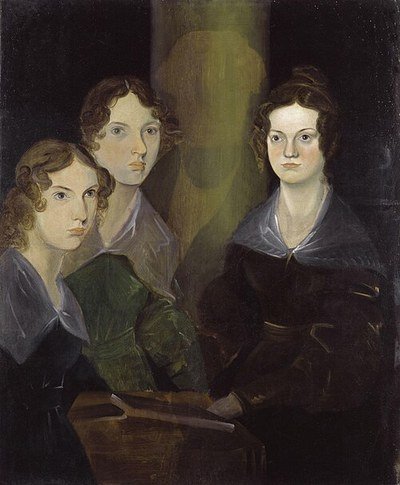
The Brontës () were a 19th-century literary family, born in the village of Thornton and later associated with the village of Haworth in the West Riding of Yorkshire, England. Born to Patrick Brontë, a curate, and his wife, Maria, the sisters Charlotte (1816–1855), Emily (1818–1848) and Anne (1820–1849) were all poets and novelists who published their work under male pseudonyms: Currer, Ellis, and Acton Bell respectively. Their stories attracted attention for their passion and originality immediately following their publication. Charlotte's Jane Eyre was the first to know success, while Emily's Wuthering Heights, Anne's Agnes Grey and other works were accepted as masterpieces of literature after their deaths.
The two eldest Brontë children were Maria (1814–1825) and Elizabeth (1815–1825), who both died at an early age. The three surviving sisters and their brother, Branwell (1817–1848) were very close. As children, they developed their imaginations first through oral storytelling and play, set in an intricate imaginary world, and then through the collaborative writing of increasingly complex stories set in their fictional world. Mary Shelley's dystopian novel The Last Man and poet Percy Shelley have been shown to have had an impact on their juvenile work. The early deaths of their mother and two older sisters marked them and profoundly influenced their writing. They were raised in a religious family. The Brontë birthplace in Thornton is a place of pilgrimage for their admirers, and their later home, the parsonage at Haworth in Yorkshire, now the Brontë Parsonage Museum, annually receives hundreds of thousands of visitors.
At some point, Patrick Brontë (born Brunty), the sisters' father, decided on the alternative spelling with the diaeresis over the terminal ⟨e⟩ to indicate that the name has two syllables. Initially, there was little certainty about which mark, if any, adorned the letter e. Multiple theories exist to account for the change, including that he may have wished to hide his humble origins. As a man of letters, he would have been familiar with classical Greek and may have chosen the name after Ancient Greek βροντή (transl. thunder). One view, which the biographer Clement Shorter proposed in 1896, is that he adapted his name to associate himself with Admiral Horatio Nelson, who was also Duke of Bronte. The title was typically spelled without a diacritical mark — as in most English sources and the Italian language — but sometimes it was, as in some Nelson biographies and Arbëresh (one of the languages spoken in the eponymous town of Bronte in Sicily at that time). The spelling Bronté was also used by some biographers, and is also found in Branwell Brontë's long poem about Nelson, Bronté.
Biography adapted from the Wikipedia article “Brontë family”, CC BY-SA. Read it there.