Anthony Munday
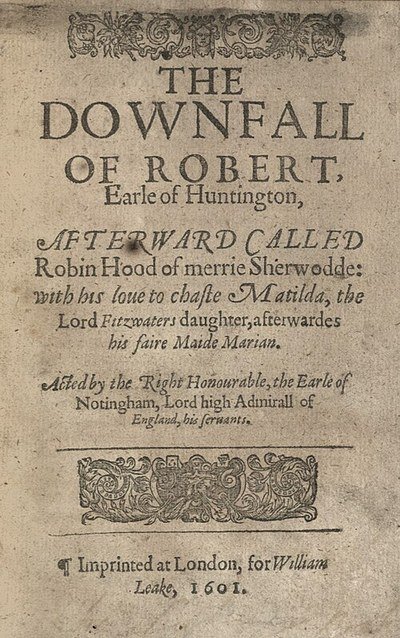
Anthony Munday (or Monday) (1560? – 10 August 1633) was an English playwright and miscellaneous writer. He was baptised on 13 October 1560 in St Gregory by St Paul's, London, and was the son of Christopher Munday, a stationer, and Jane Munday. He was one of the chief predecessors of Shakespeare in English dramatic composition, and wrote plays about Robin Hood. He is believed to be the primary author of Sir Thomas More, on which he is believed to have collaborated with Henry Chettle, Thomas Heywood, William Shakespeare and Thomas Dekker.
Munday was once thought to have been born in 1553, because the monument to him in the church of St Stephen Coleman Street, since destroyed, stated that at the time of his death, he was eighty years old. From the inscription we likewise learn that he was "a citizen and draper". In 1589 he was living in the city, and dates his translation of The History of Palmendos "from my house in Cripplegate". That he carried on the business of a draper or had some connection with the trade as late as 1613, may be gathered from the following passage at the close of The Triumphs of Truth, the city pageant for that year, by Thomas Middleton: "The fire-work being made by Maister Humphrey Nichols, a man excellent in his art; and the whole work and body of the Triumph, with all the proper beauties of the workmanship, most artfully and faithfully performed by John Grinkin; and those furnished with apparel and porters by Anthony Munday, Gentleman." The style of "gentleman" was probably given to him with reference to the productions of his pen.
Biography adapted from the Wikipedia article “Anthony Munday”, CC BY-SA. Read it there.