Alexander Pope
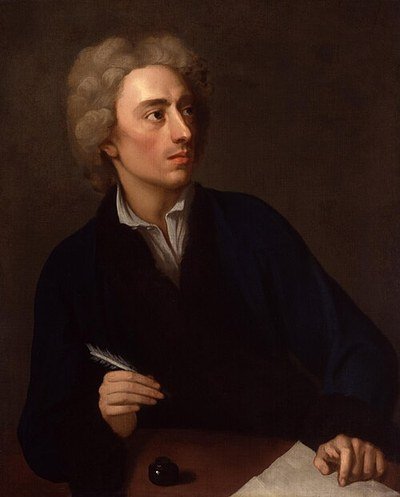
Alexander Pope (21 May 1688 O.S. – 30 May 1744) was an English poet, translator, and satirist of the Enlightenment era who is considered one of the most prominent English poets of the early 18th century. An exponent of Augustan literature, Pope is best known for his satirical and discursive poetry including An Essay on Criticism (1711), The Rape of the Lock (1712–1717), The Dunciad (1728–1743), and for his translations of Homer.
Pope is often quoted in The Oxford Dictionary of Quotations, some of his verses having entered common parlance (e.g. "damning with faint praise" or "to err is human; to forgive, divine").
Alexander Pope was born in London on 21 May 1688, the year of the Glorious Revolution. His father Alexander Pope was a successful linen merchant in the Strand, London. His mother was Edith Turner, a daughter of William Turner, Esquire, of York. Both parents were Catholic. His uncle-in-law was the miniature painter Samuel Cooper, through his mother's sister, Christiana. Pope's education was affected by the recently enacted Test Acts, a series of English penal laws that upheld the status of the established Church of England, banning Catholics from teaching, attending a university, voting, and holding public office on penalty of perpetual imprisonment. Pope was taught to read by his aunt and attended Twyford School circa 1698. He also attended two Roman Catholic schools in London. Such schools, though still illegal, were tolerated in some areas.
Biography adapted from the Wikipedia article “Alexander Pope”, CC BY-SA. Read it there.